Single-day, single-shift examination in offline pen-and-paper mode.
CURRENT OFFICIAL REFERENCE · NEET (UG) 2026
Understand the NEET Paper
Understand the NEET Paper
Before You Sit for It.
The exam pattern tells you how the three subjects are distributed, how marks are awarded, how negative marking works, how the pen-and-paper test is structured, and what the 180-minute examination actually demands from a NEET aspirant.
EXPLORE THE PAPER ↓
Official pattern first · Academy guidance clearly labelled
180Compulsory Questions
720Maximum Marks
180Minutes
3Subjects
01 · PAPER AT A GLANCE
NEET Exam Pattern — Quick Overview
These are official NEET (UG) 2026 pattern facts. The next official bulletin for a future exam year should always be checked again.
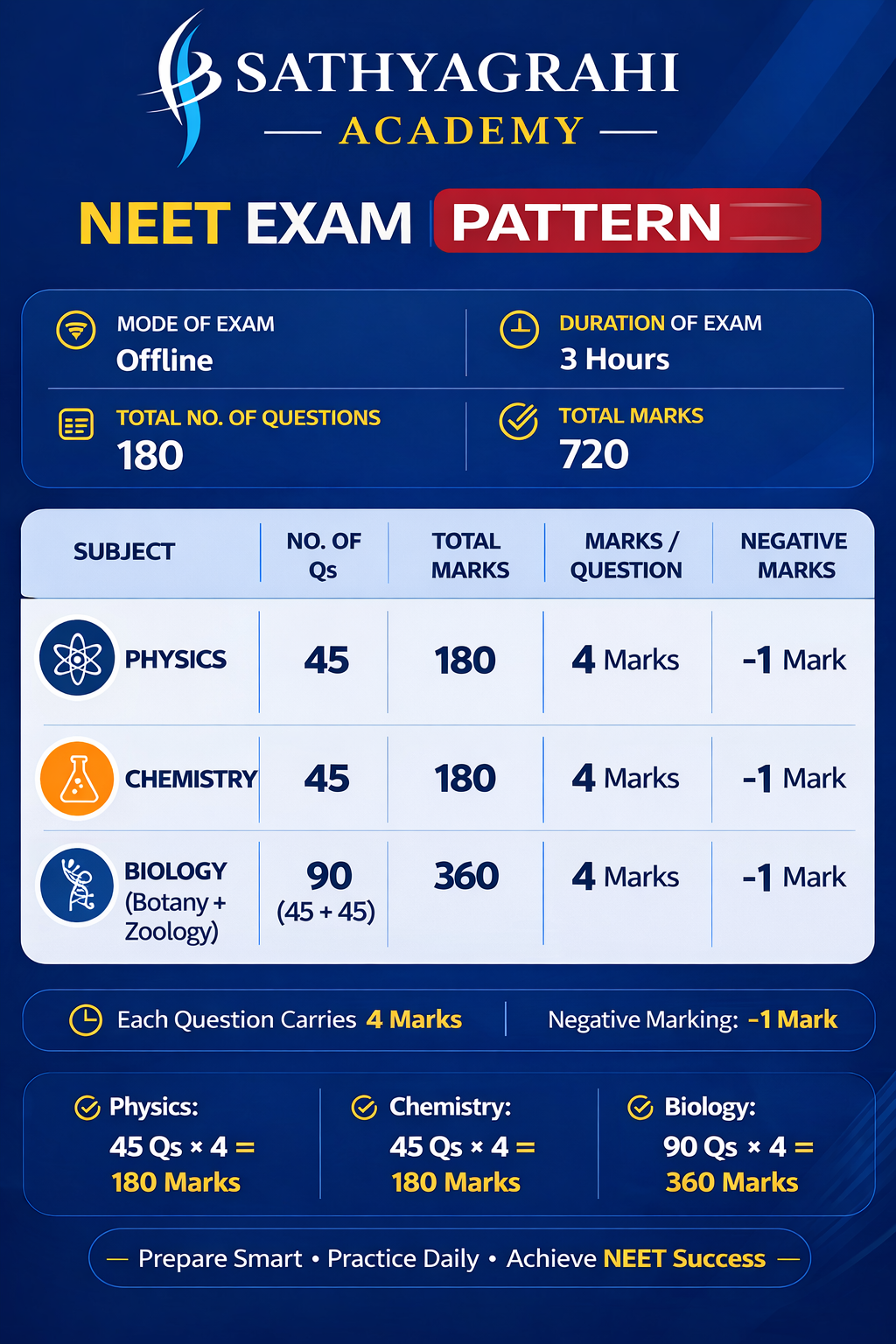
180 compulsory questions to be completed in 180 minutes.
Physics 180 + Chemistry 180 + Biology 360.
Four options with one correct answer / best option.
FROM YOUR ACADEMY MATERIAL
One Visual. The Whole Paper.
Your existing Sathyagrahi Academy exam-pattern poster matches the current 2026 official structure: 45 Physics, 45 Chemistry, 90 Biology, 180 total questions and 720 marks.
SEE SUBJECT BREAKDOWN →02 · SUBJECT-WISE STRUCTURE
How the 720 Marks Are Distributed
Biology carries half of the total paper, while Physics and Chemistry each carry one quarter.
P
PHYSICS45 Questions
180Marks
25% of total marks. Every question carries 4 marks before any negative marking.
C
CHEMISTRY45 Questions
180Marks
25% of total marks. Same number of questions and marks as Physics.
B
BIOLOGY90 Questions
360Marks
50% of total marks. Biology covers Botany and Zoology together.
45 Physics+
45 Chemistry+
90 Biology=
180 Questions
03 · MARKING SCHEME
Every Answer Changes Your Score
NEET uses positive marks for a correct answer and negative marking for an incorrect answer.
CORRECT+4Four marks
WRONG−1One mark deducted
UNANSWERED0No mark
Basic score formula(Correct × 4) − Wrong
IMPORTANT OFFICIAL CASES
More than one option is correct
All options are correct
Question is wrong / dropped
What If a Question Has a Problem?
+4 is awarded to candidates who marked any of the officially correct options.
+4 is awarded to candidates who attempted the question.
+4 is awarded to all candidates who appeared, whether attempted or not.
04 · MODE, OMR & LANGUAGE
What “Pen & Paper” Means for You
The question booklet is physical and answers are recorded on an OMR answer sheet. Exam-day OMR instructions must be followed exactly as issued by NTA.
Q. 27Choose one option
ABCD
One question → one selected response
NEET (UG) 2026 is officially notified as a single-day, single-shift examination.
English, Hindi, Assamese, Bengali, Gujarati, Kannada, Malayalam, Marathi, Odia, Punjabi, Tamil, Telugu and Urdu.
Regional-language candidates receive English + the selected regional language. For translation ambiguity, the English version is treated as final.
05 · SATHYAGRAHI ACADEMY GUIDANCE
How to Think About 180 Minutes
This is guidance, not an NTA rule. Your final subject order and time split should come from repeated full-length mock-test analysis.
Move through questions you can answer with confidence. Avoid getting trapped early in one difficult problem.
Use your second pass for questions that need calculation, recall or deeper checking.
Keep a protected review window. Your goal is not maximum attempts; it is maximum accurate score.
EXAMPLE STARTING RANGEBiology70–75 min
EXAMPLE STARTING RANGEChemistry45–50 min
EXAMPLE STARTING RANGEPhysics45–50 min
PROTECTED BUFFERReview / OMR10–15 min
The ranges above are only a starting framework. Stronger/slower subjects differ by aspirant; mock-test data should decide your personal plan.
06 · UNDERSTAND YOUR SCORE
NEET Score Calculator
Use this to see how correct answers, wrong answers and unattempted questions combine into a score.
YOUR SCORE
580
/ 720
150 correct × 4 − 20 wrong = 580 marks
Total entered questions: 180 / 180
07 · COMMON CONFUSIONS
Questions Aspirants Commonly Ask
Short answers first. Detailed exam-day instructions should always follow the latest official bulletin and admit-card instructions.
Are all 180 questions compulsory?
Yes. The 2026 official pattern states that the paper has 180 compulsory questions to be attempted in 180 minutes.
Is there negative marking?
Yes. A correct answer gets +4, an incorrect marked answer gets −1, and an unanswered question gets 0.
Is NEET online or offline?
NEET (UG) 2026 is notified in pen-and-paper mode, using a physical test booklet and OMR response sheet.
Is Biology really half of the paper?
Yes. Biology has 90 questions carrying 360 marks out of the total 720 marks.
Do I have to follow a fixed subject order?
The official pattern section defines subjects, questions, marks and duration; it does not prescribe an Academy time split. Build your attempt order through mock-test practice while following all booklet/OMR instructions.
Can I write the paper in Telugu?
Yes. Telugu is one of the 13 listed media for NEET (UG) 2026, with availability subject to the official examination-centre language rules.
CURRENT OFFICIAL REFERENCE
OPEN OFFICIAL NEET WEBSITE ↗
NEET (UG) 2026 Information Bulletin
The current page is based on the official 2026 examination scheme: 180 compulsory MCQs, 720 marks, 3 hours, +4/−1/0 marking and pen-and-paper mode. For NEET 2027, this page should be re-checked when the competent authority publishes the 2027 bulletin.